No, AI Tutors are Not Replacing Educators
I'm exhausted by AI boosters saying some really stupid things
There are some talking points about instructional design and AI that keep popping up in my feed. They’re usually one of these themes: courseware is dead, AI tutors are the future, customized learning will fix everything, and the sooner you luddites accept that, the better.
Warning! I am genuinely tired of hearing opinions from people who haven’t spent time in a classroom and don’t understand this technology.
The EdTech Industry Has a Credibility Problem
Before we even get into the reality of AI capabilities and impact, let’s talk about the track record.
The U.S. has spent more than $30 billion putting laptops and tablets into the classrooms. We had a pandemic that was basically EdTech’s dream situation: a bunch of schools forced to do everything in virtual classrooms. So, in 2026, what’s the return on that investment? Gen Z is the first generation in modern history to score lower on standardized tests than their parents.
Neuroscientist Jared Cooney Horvarth testified before the Senate Commerce Committee about this, and the data is pretty damning. Studies from PISA, TIMSS, and PIRLS all show that higher screen time correlates with lower performance. If you don’t want to read the testimony, I’ll just drop the PISA chart here for convenience:
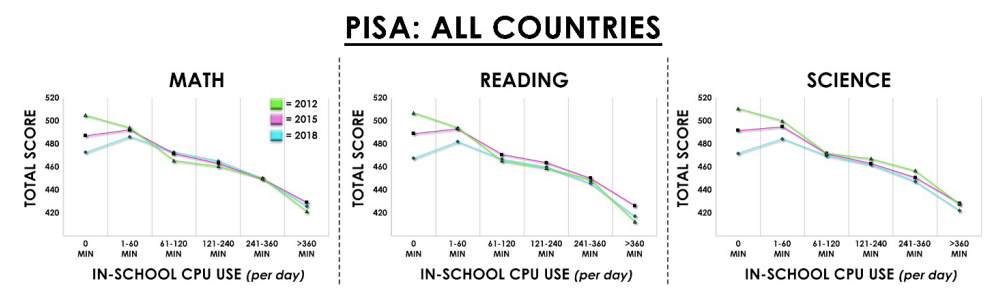
The industry that brought us this track record is now telling us to trust them with something more fundamental: replacing instructional designers and educators entirely.
It is absolutely astonishing to me that, in the face of this much data, a rush to embed AI across all aspects of education isn’t met with more skepticism. Look, I run an education company, yes, we have AI tools available, and yes, they even provide some value. But the way these boosters talk, deploying tools at scale, in the absence of, you know, actual data, is reckless.
Even more frustrating is the talk from our congress-critters about “falling behind” countries like China. You know something China is doing differently than us? They’ve been restricting classroom technology and phone use in schools.
And this is what drives me crazy as a technologist and educator. I’m open to being convinced of just about anything, provided you can show me the data.
Yes, I understand that learning efficacy has a lot of contributing factors, and technology is only one of those factors. However, we did put a man on the moon with humans doing all the math, mostly by hand.
We have centuries of human experience that says you don’t need a computer screen to learn math. Technology’s role is most often that of an amplifier, and no matter how good the tech is, multiplying by zero is still zero.
The Incoming AI Apocalypse
I’ll admit, the argument has a seductive logic. People have been anthropomorphizing AI tools for a while now. Imagine a world where every student has a personalized AI tutor. One that can adapt, respond, and personalize the learning experience. Why spend the time and effort building static courses when the model can just… mentor the learner?
If there’s one thing I’ve learned in my decades on this planet, it’s that people love simple, hope-filled ideas. But if you understand the current tech and human nature, you should realize this doesn’t survive 5 minutes of critical thinking.
The Learner Problem
Let’s start with who this is actually supposed to work for.
Self-directed learning, whether AI-assisted or not, is made for a specific learner profile: someone who is motivated, has enough knowledge to ask useful questions, and has the self-awareness to recognize when they have a fundamental misunderstanding of a topic. And, as someone who has spent over a decade teaching some really smart people how to code, I can assure you this is a narrow slice of the population, and it’s almost never the learners who need the most support.
Let me give you an example. I recently taught a coding course filled with pre-qualified adult learners. On day one, they ask if they can use AI to help them learn. Sure, why not? As long as they’re attending class and they can explain themselves in code reviews, I have no issues with AI assistance.
However, by the third week, almost no learners were using it that way; instead, they came to me with questions. Why? The expertise reversal effect. In short, unstructured, exploratory learning works best for advanced learners. For novices, it doesn’t. Novices don’t know what they don’t know. They’re unable to steer a conversation towards the right content because they don’t yet understand the territory. So what did this look like in practice? Well, I asked the learners why they weren’t using Claude (the best coding assistant, in my not-so-humble opinion) more. Here’s what I got:
- It kept using syntax that we hadn’t covered in class yet.
- I was confused, but it just kept using the same examples over and over, as if that would help.
- I lost a couple of hours because it took me down a rabbit hole that wasn’t relevant to what I needed to learn.
The danger of AI tutors is that what appears to be personalized learning can easily lead to distraction, demotivation, and frustration. Especially since LLMs, the AI flavor du jour, hallucinate. Hallucinate is a marketing-friendly term for “confidently made some shit up that isn’t correct because these models are predictive rather than factual.” How is a novice supposed to catch a hallucination? They don’t know the material!
The Structure Problem
I feel like I’ve put the cart before the horse because I just put the learner in the tutoring scenario, but the issues start way before the chatbot comes online. You see, unlike many of these AI boosters, I’ve built LLM-powered software. And, this idea that you’re going to create a tutor from a prompt is… well, it’s bulls***.
If you actually want to build a decent chatbot, you need to give it context. And guess what? Creating good context is actually more difficult than creating courseware. Let me explain why.
LLMs have limited memory in a given conversation. This is called the context window. For non-technical readers, the context window is basically your conversation, with some hidden extra data injected into it to help you out. Also, because of how the math works, as more information gets pushed into the context window, the more likely you are to have hallucinations. This has been confirmed by multiple studies; here’s one. The mic-drop quote is this:
Our systematic experiments across 5 open- and closed-source LLMs on math, question answering, and coding tasks reveal that, even when models can perfectly retrieve all relevant information, their performance still degrades substantially (13.9%--85%) as input length increases but remains well within the models' claimed lengths.
There is a technique called Retrieval Augmented Generation (RAG), which helps LLMs by injecting relevant information into the context window. However, RAG works best when you “chunk” the data into small pieces and only retrieve the minimum information necessary to answer a given query. And that is much more difficult than writing a lesson.
So I ask the AI booster, "What’s your plan for this?" Shove a whole textbook into context? Good luck with that, because it doesn’t work. If there’s no curriculum, then no one has made principled decisions about sequencing. No one has mapped the prerequisites, measured what the learner actually knows, or what types of examples, metaphors, or approaches work best for them.
Yeah, it’s much easier to say “don’t worry, just pay us and watch our AI tools shit out a bunch of unverified content and then let the AI improvise in real time”.
The Auditing Problem
But, okay, let’s say you ignore everything I said so far and roll out AI tutors at scale anyway. After all, they’re adaptive, they’re personalized, and damnit, they’re the future! Great, now answer me this: How do you know if they’re working?
With courseware, auditing is straightforward. You have assessments, completion rates, and score distributions. You know where learners are struggling because you designed the checkpoints. With an adaptive AI tutor, every single learner has a completely different conversation. Are you going to log all of them? Who’s reading those logs? What are you even measuring? Time on task? That’s not learning. Completion? Of what, exactly?
And that's just the learners who show up. What about the disengaged ones who open the chat, type "I don't know" twice, and close the tab? What about the ones who are struggling but can't articulate why, so the bot just keeps cheerfully generating content into the void? At least a human educator notices when someone has checked out. The bot does not.
This is a fundamental accountability gap. If you can’t measure it, you can’t improve it, and you certainly won’t be able to defend it to the institution, the employer, or the parents who paid for it. Again, the types of learners who would engage well with a chatbot are likely to be more self-aware, quick to learn, and naturally curious. So, what you’re likely to end up with is massive selection bias and a product that looks like it’s working right up until you look into who exactly it’s working for.
The Cognitive Science Problem
I believe that cognitive load theory is one of the key differentiators in quality learning experiences. In short, human working memory is limited. Novice learners already grappling with new concepts cannot simultaneously manage the meta-tasks of deciding what to ask, evaluating whether the answer is good, and steering a conversation productively.
Good instructional design deliberately manages cognitive load with worked examples, scaffolded complexity, carefully sequenced practice, and appropriate pacing. A free-form AI interaction does none of this by default. For a struggling learner, it can be the worst of all situations: unlimited information, little structure, and no one taking emotional cues that they’re lost, or frustrated, or cognitively exhausted.
This is where adaptive learning would appear to shine, but again, it doesn’t hold up to scrutiny. Most adaptive systems infer knowledge from performance on discrete tasks: did you get the answer right or wrong? But that's a crude proxy for understanding. A learner can get the right answer for the wrong reason.
I know you’ve taken multiple-choice tests before. Have you ever gotten the right answer by pattern-matching and educated guessing? I know you have!
Learners can pattern-match without comprehension. They can get lucky. And they can fail a question not because they don't understand the concept, but because the question was poorly worded, or because they were tired or anxious. Cognitive state is not the same as knowledge state, and conflating the two leads to an adaptive system that adapts to the wrong thing.
There’s also the issue of desirable difficulty. The short of it is that the right degree of struggle is required for effective learning. Again, I can use my experience teaching coding as an example. There are certain concepts that learners need to bang their heads against for a while before they click. And, let me assure you, AI coding assistants can complete every…single…one of my exercises and projects. But, like most complex topics, the learning builds on itself. If I just give someone the answer early on to shield them from struggle, I can nearly guarantee they'll fail the course weeks later.
This is also where EdTech needs to be scrutinized closely. They are all-in on vanity metrics. Now, let me be clear, my instruction is fun, and I get really high survey results, but at the end of the day, I don’t give a crap if my students like me because my job is to make them competent. You can take your Net Promoter Score and shove it directly where the sun doesn’t shine.
I’ll tell you what’s likely to happen with EdTech-powered AI tutors. They’re going to optimize for engagement and learner satisfaction scores, which will almost certainly mean optimizing for desirable difficulty. It will smooth out the struggle because struggle feels bad, and feeling bad is bad for retention metrics.
The Role of the Educator
You know how I recognize someone who has never stepped into a classroom? They fundamentally misunderstand the role of an educator. Let me say this clearly for the folks in the back of the room.
Educators are not content pipes. They are not search engines with office hours.
A good instructor notices when a student is disengaged. They can detect when the class’s brains are full and take their foot off the gas. They know whether they’re ready to move on to the next unit. And, most importantly, they carry the relationship across time. Remember the context window? Not an issue with human instructors. They remember last week’s struggle and connect it to this week’s breakthrough. They assess and credential, signaling to the world what a learner has achieved.
I’ve written at length about how important that assessment is, especially since AI tools can complete most of the performative nonsense that schools have been relying on. That part of the role will become even more important going forward.
An AI tutor without structured outcomes has no anchor for any of this. It can simulate empathy. It can generate encouragement. But it cannot bear witness to a learner's growth in a way that means anything beyond the chat window.
The question isn’t whether AI can deliver information. It clearly can. Hell, I use it every day, but I’m an expert who can confidently ignore it when it goes off the rails. I’m not fooled by it generating a faulty lesson in my area of expertise. And, trust me, the number of times I have ever been satisfied with the output without significant rewrites is zero.
AI Has a Role, This Isn’t It
AI is changing instructional design and instruction. As I said, my team uses AI tools only when they increase quality. But I personally train my team. They understand the tools, they understand the limitations, and they absolutely understand that if they skip the “human-in-the-loop” part, I will drop kick their ass to the unemployment line.
These tools should raise the bar for what good design and good learning experiences look like. The grifters and boosters are trying to flood the space with their slop, and it's on us to defend the next generations.
Besides, as someone who teaches AI literacy, do you know what the most effective way to use AI tools is? It’s to know what you’re doing. You’d be amazed at what it can do in the hands of a capable operator.
