
Et Tu, Anthropic?
In which Anthropic stabs a major customer in the back
On April 17th, Anthropic announced the release of Claude Design. Naturally, the media carried the water without any critical thinking, and the markets punished design companies like Figma. And, once again, I am being proven right about the dangers of building critical business processes on someone else’s infrastructure.
This Isn’t the First Time
Anthropic has now established a pattern of letting others figure out how to use its models more effectively, only to pull the rug out from under them. Remember Cursor? They’re still around, but in January, Anthropic started cracking down on harnesses that let users spoof their identity, tricking servers into thinking the request came from their own CLI.
This is problematic for Anthropic because they restrict the speed and usage of Claude Code for many reasons, but primarily because subscriptions are heavily subsidized. There is conjecture that Anthropic is providing $8- $13 in compute per dollar of subscription revenue.
Now, to be clear, Anthropic’s move is absolutely rational. They want to force high-volume users to the API, where they can charge more, or keep them in the Claude Code garden, where they can control the rate limits. However, this rippled through Cursor’s business because users could no longer use the service as intended.
This was a bright red warning sign for any business thinking about building critical services on top of someone else’s infrastructure and models. If your provider changes the rules, you have virtually no way to protect yourself.
If you build dependencies on someone else’s infrastructure and models, you aren’t running a business, you’re renting one.
These days, time moves so quickly, and there’s so much slop flooding the zone that you need to take a step back and realize that Cursor was released in 2023, while Claude Code wasn’t released until 2025. I have frequently stated that Anthropic’s models were the best code assistants during this timeframe, and Cursor was paying Anthropic a lot of money for that use.
So, when coding assistance turned out to be one of the few good use cases for these models, what did Anthropic do? They released a competing product.
Thanks for doing the product-market fit for us! Good luck out there!
The Figma Situation
Figma is another business that has been using frontier models heavily in its service offerings. They went all-in on using models from Anthropic, OpenAI, and Google to add AI to their subscription software. So, how is that going? Let’s check the stock performance year-to-date:
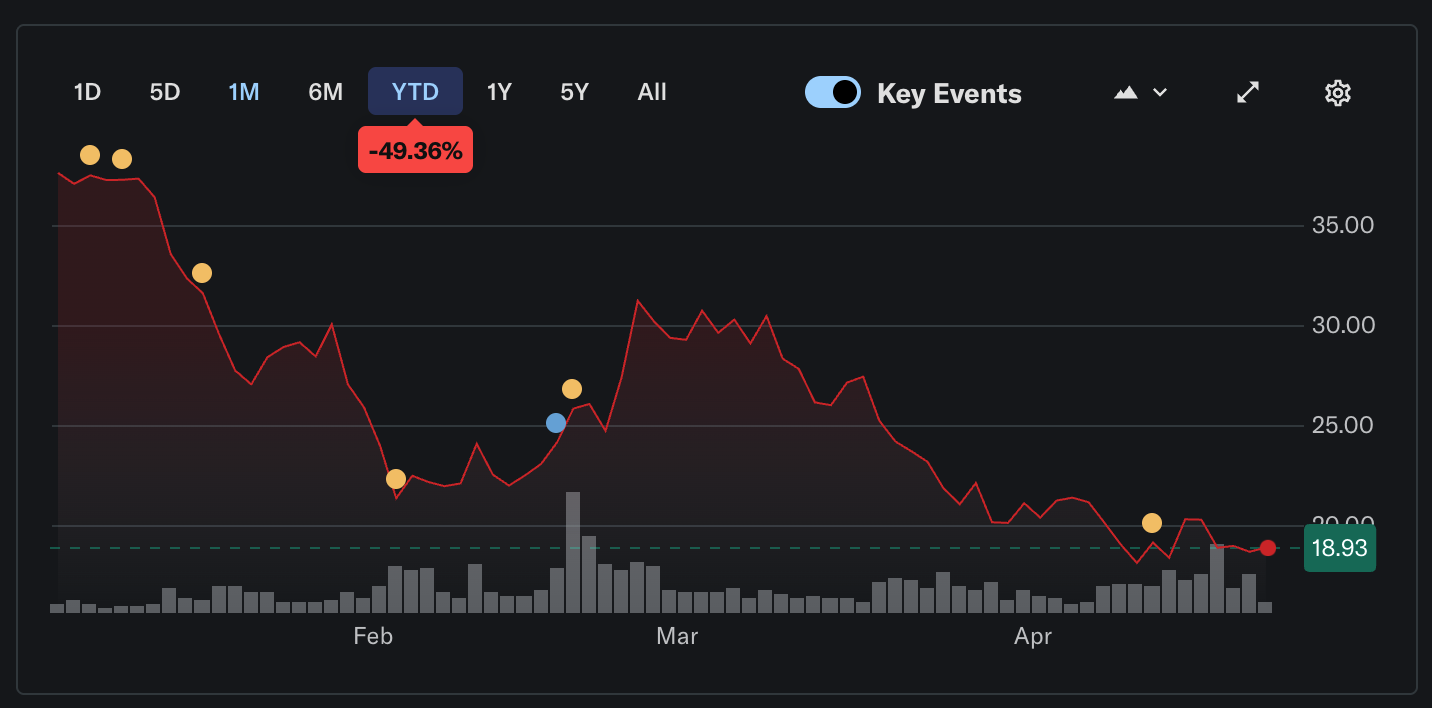
Oh dear, it’s not looking good for Figma. And now, Anthropic has launched a design product that directly competes with their offering. Will Anthropic pull the same stunt that they did with Cursor? Will they start making Figma’s API calls more expensive? Throttle them? Maybe even block them entirely since they’re now a “competing product”? It’s too early to tell, but if I were on the board of Figma, I would ask my idiot leadership team why they thought sending all their data to the plagiarism machine was a good idea.
Keep in mind, this is a company that earlier this year bragged about its integration with Claude Code. I’d love to be in the executive conference room to hear the discussions.
This is a Big Tech Pattern
Embrace, extend, extinguish was a phrase my technical peers used to toss at Microsoft back in the day, but these days, everyone is doing it.
Consider Amazon Basics' business model. They build a platform, control the data, and then use that data to identify which business customers are selling products they can undercut. Thank you, “business partners,” for giving us what we need to cut your throat.
I predicted this over a year ago. You can’t spend over $1T on infrastructure and make it back on compute alone. These AI providers are on a never-ending spending treadmill. They have to continuously train new models, or they’ll fall behind their competition. They also have to continuously invest in newer, more powerful processors from companies like Nvidia or, you guessed it, they’ll fall behind their competition.
Add to that the fact that energy prices are soaring, which directly shrinks their margins, and that they don’t have enough electricity available to power the processors they’ve pre-purchased. Debt is getting more expensive, and raising money is getting harder. What we have here is an environment where the only path that makes sense is to identify which services your customers are successful with and then copy them.
Or, put more simply: the moment your product or service can be fully provided by an LLM is the moment your business ceases to have any value in the market.
Executives are Surrendering Their Leverage
I find it interesting, given my long career in tech, that the American tech space has always been very anti-union. When workers are unionized, they have more power to push for better benefits, compensation, and treatment. Too many executives are very excited about the prospect of replacing humans with LLMs because they imagine a world where they have a 24/7 employee that never asks for a raise, doesn’t take a day off, and doesn’t require any respect or human rights.
What I find interesting is that if these companies replace employees at scale with AI bots rented from another company, they will have even less leverage than they have over their human workers. As soon as the company no longer has the in-house skills to perform the work, their AI providers can charge pretty much whatever they want, and the company will have to bend over and pay it. With humans, you have leverage, because they need jobs to live. With an AI provider, there is nothing you can threaten them with to bring them back to the table. They can just wait for your business to die or copy your services.
Think about this. If a CEO decides to build an entire agentic workflow around a particular vendor and model, it becomes cost-prohibitive to replace it. You won’t have the expertise; different models behave differently, so your entire workflow will need to be rebuilt and retested, and because these tools are non-deterministic, the new version may not even be good.
They are so fucked, and they don’t know it.
